

Arizona gets a little help from Frankie as they make their way through Mount Royal Cemetery in Montreal. Art by Arizona O’Neill.
I like a good horror story. I have since I was a child. Arizona O’Neill’s Opioids & Organs—although it includes Frankenstein’s monster, Dracula, grave robbers, a two-headed dog, and plenty of additional horror tropes—isn’t one. In this book, these typically ghoulish subjects are outpourings from O’Neill’s mind as she explores the complexities of human organ donation and procurement with the disarming honesty of a postmortem examination.
The real monster in the book is personal struggle: Arizona’s father, Chris Peters, dies at age 41 from a fentanyl overdose. It falls to 21-year-old Arizona to sign off on the donation of his organs. Not long after, she receives a thank-you letter from the recipient of her father’s heart. Those around Arizona make their expectations clear: She should feel good about the organ donation. Instead, she’s angry, confused, and consumed by macabre thoughts. She sees dismembered body parts in everyday situations—figments of her imagination intruding on ordinary life.

Body parts abound. Art by Arizona O’Neill.
Fixations and daydreams
The book is a memoir of Arizona’s quest to understand her fixations. She transports us across time and place, exploring the moral ambiguities and injustices marbled throughout the organ procurement process. These journeys unfold as daydreams—wonderlands where reality and fantasy merge to express O’Neill’s singular point of view. There are plenty of dead people in this wonderland.
Most destinations share an academic theme: the England of Frankenstein author Mary Shelley; the Maude Abbott Medical Museum at McGill University in Montreal; Marsh’s Library in Dublin; Harvard Medical School near Boston; and two stops in Paris, the Louvre museum and the Paris Catacombs. Each visit traces society’s shifting attitudes toward human remains and deepens O’Neill’s critique of how bodies are studied, displayed, and used.
O’Neill presents a compelling critique of a system that frames the deaths of marginalized people as “mixed blessings” that provide usable organs for the benefit of those with greater privilege. The exploitation she depicts is more sickening than the gore.
Deeper struggles
Her father’s death triggers and intensifies Arizona’s struggles; it doesn’t create them. The author reveals preexisting emotional challenges, embodied by her imaginary companions Frankie and Izzy.
Frankie is Frankenstein’s monster—though he objects to being called either Frankenstein or a monster. He is a sensitive presence who embodies Arizona’s vulnerability and carries her, literally and figuratively. Izzy is a sarcastic yellow gecko who represents Arizona’s anxiety, obsessions, and compulsions. The pair externalizes her emotional states and provides moments of comic relief amid the book’s weighty material.

Arizona takes her inner entourage on the road to the Paris Catacombs. Art by Arizona O’Neill.
My favorite sequence is Arizona’s visit with her mother, who wins my vote for best supporting character because of her outsized impact despite her brief appearances. We first see her in a flashback as a young mother living in drug-laden squalor with Arizona’s father, Chris, whom she leaves to protect the welfare of her new baby. Later, she appears as a non-mournful mourner at Chris’s funeral. When Arizona visits her mother in Dublin, she is a notable author conducting research. Their scenes leave plenty to unpack: guilt, generational trauma, and the interplay of inherited and learned traits.
Anatomy of the art
The book is unapologetically morbid. The ubiquitous body parts reminded me of a trip through an oddities museum, where grotesque allure collides with unsettling reality. (I was a little queasy at the Mütter Museum in Philadelphia.)
O’Neill’s illustrations perfectly match the book’s subject matter. Her smooth, clean linework reminds me of the clinical detachment of medical and technical illustration. Yet her deliberate strokes, composition, and color choices convey feeling, fantasy, and mood. Add her unique point of view, and the result is a visual narrative that is distinctly her own.
Little bits
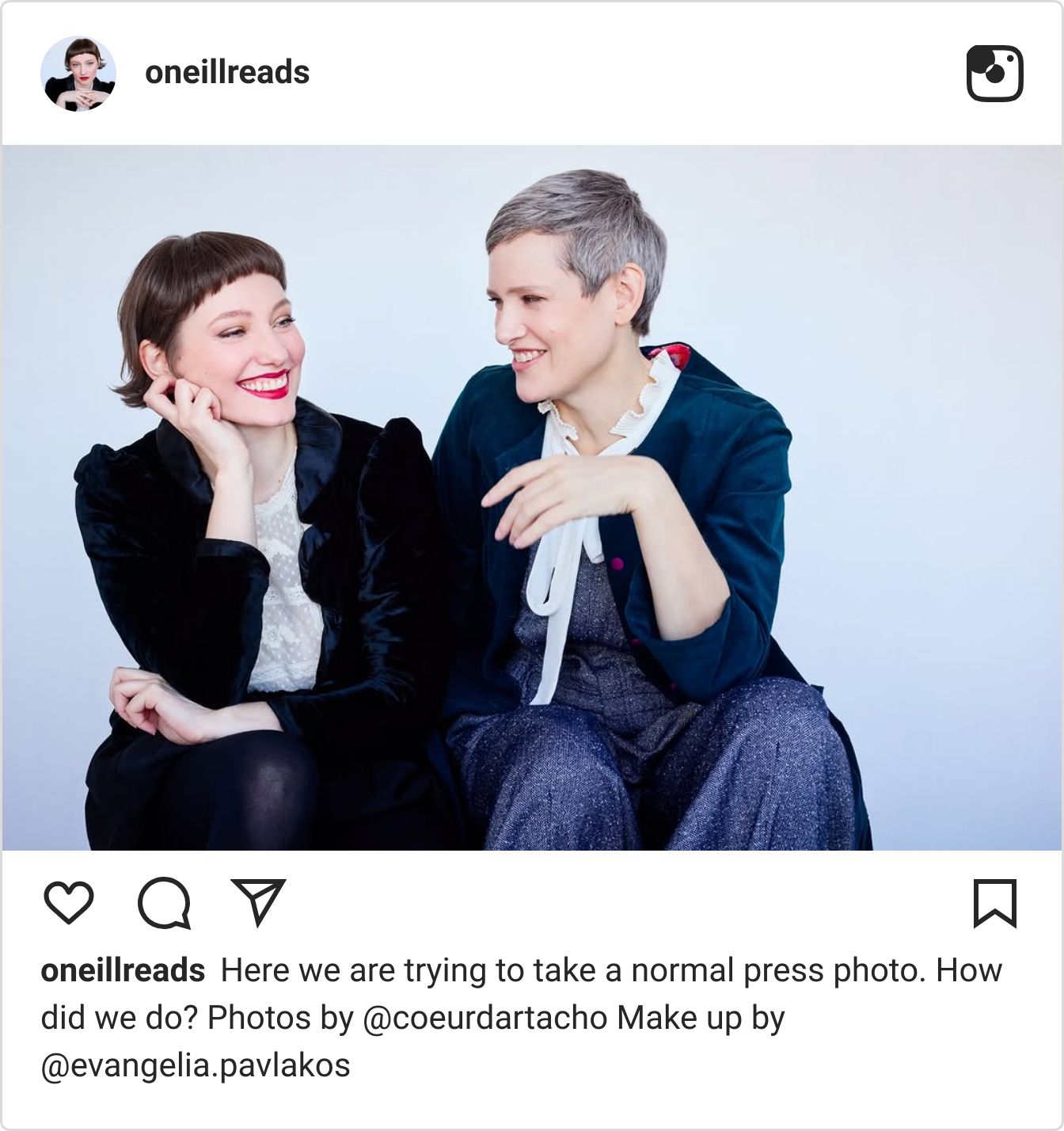
Arizona’s mom. Arizona’s mother, who is not named in the book, is the award-winning author Heather O’Neill. Mother and daughter appear together in a post from their shared book-recommendation account.
Transparencies. O’Neill dispenses with subtlety, crashing through the fourth wall and blatantly outing what Frankie and Izzy symbolize.
Unabashed struggle. I don’t know a person who doesn’t wrestle with some type or degree of emotional struggle, yet it’s difficult for many people to acknowledge. O’Neill makes it seem refreshingly ordinary.
Right out of the gate. The book’s illustrated endpapers set a delightfully morbid tone immediately. A hexagonal pattern of delicately rendered organic vines frames images of bones and organs. Bloodish-red linework sits against a matte-black background. The body parts are presented as beauty, not gore.
Relating. I empathized with Arizona while reading Opioids & Organs. I am the child of an estranged father who struggled with substance abuse. He died when I was about the same age Arizona was when her father died. I recognized the difficulty of piecing together an image of a flawed father. What we see in the book is a snapshot that, in my experience, continues to evolve over a lifetime. Here’s hoping O’Neill takes us on another leg of this journey someday.

Art by Arizona O’Neill.
DETAILS

’Opioids & Organs’
Creator: Arizona O’Neill (writer and illustrator); website, Instagram
Publisher: Drawn & Quarterly Publications; May 19, 2026, hardcover, 380 pages


